Do you need a halal payment gateway?
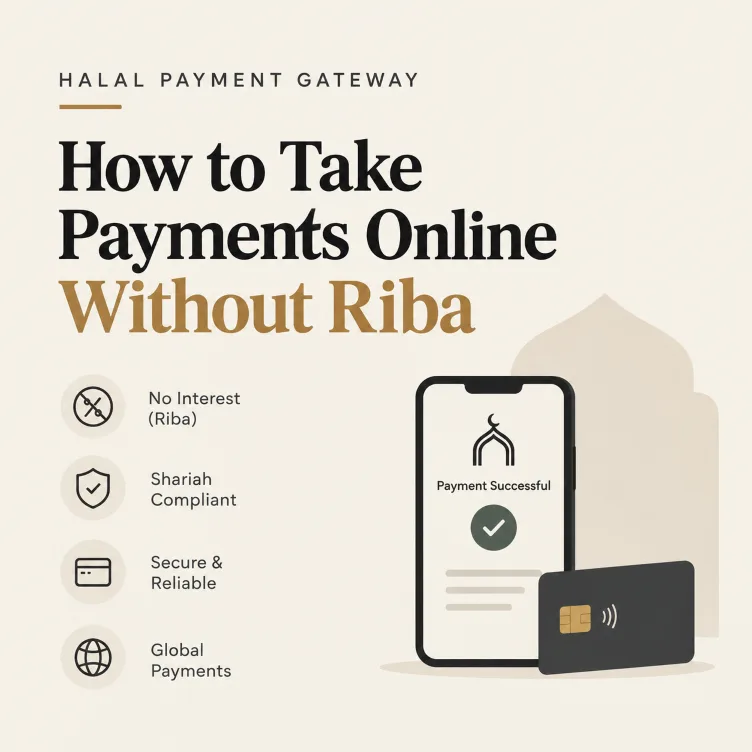
No, not in the way most people mean it. There is no special halal payment gateway you have to find before you can sell online, and the mainstream card processors are not haram to use. Taking a card payment and paying the processor a fee for handling it is a service arrangement, not a loan. Where riba actually gets into an online business is around the gateway, not inside it: in how you price card payments, how you treat late invoices, what financing you offer at checkout, and where the money sits once it lands.
So this guide is not a list of "Islamic" payment brands. It is a map of the four places riba tends to slip into an otherwise clean payment setup, with the rulings that draw each line and what to do instead. Some of these questions are settled. Some are genuinely disputed among scholars, and we will say which is which rather than pretend.
Why taking card payments is permissible
The worry usually sounds like this: "My customer might be paying with an interest-bearing credit card. Am I part of that?" The answer from Islam Question and Answer is clear. A seller may be paid by credit card whether or not the customer's card is itself acceptable in Shariah, because any sin in the customer's credit arrangement is borne by the bank and the customer, not the seller. The same ruling permits the seller to pay the bank a commission for facilitating the transaction.
That covers the core of any online payment setup. You sell a product, the customer pays, a processor moves the money and keeps a fee for the work. Nothing in that chain is a loan from you, and nothing in it charges anyone for time. That is the test to keep coming back to: riba appears when money is charged for the passage of time on a debt, not when someone is paid for doing a job.
Where riba actually gets in: four places to check
Once you accept that the gateway itself is fine, the useful work is checking the edges. These are the four we see most often when reviewing how a Muslim business takes money online.
1. Passing the card fee on to the customer
This is where even a single source disagrees with itself, which is a good sign the question is genuinely open. The same IslamQA ruling above says the processor's commission is permissible so long as it is not charged to the purchaser, citing the Islamic Fiqh Council's condition that a card sale be priced the same as a cash sale. A later answer from Islam Question and Answer states that scholars differed on whether the purchaser may be made to pay the fee, and that its own view is that there is nothing wrong with it.
For most businesses selling to the public in the UK, the law has settled the practical question anyway. In a written answer to Parliament, the UK Treasury confirmed that surcharging customers for their choice of debit or credit card has been banned since 2018 under the Consumer Rights (Payment Surcharges) Regulations 2012, for most retail payments. If you sell to consumers elsewhere, check your own country's rules. Either way, the cleanest approach satisfies both the stricter scholarly view and the law: build your processing costs into the price you advertise, and charge one price however people pay.
2. Interest on late invoices
This one catches service businesses, agencies and wholesalers far more than shops, because UK law actively hands you an interest tool. The Small Business Commissioner explains that when another business pays you late, you can charge statutory interest at 8% plus the Bank of England base rate, along with a fixed sum of compensation for the cost of recovering the debt. Invoicing software will often add the interest line for you.
That statutory interest is a charge for time on a debt, which is the plainest form of riba. A Muslim business should not claim it, however legal it is, and should switch off any automatic late-interest setting in its invoicing tools. The fixed compensation for recovery costs is a separate question with its own rules, and worth asking a scholar about before you rely on it.
What about a late fee that goes to charity instead of to you? Here scholars genuinely differ. On one side, Dr Muhammad al-'Usaymi, quoted by Islam Question and Answer, rules that a late-payment penalty is riba even when the lender claims it will be donated to charity. On the other, an answer from Shaykh Irshaad Sedick at SeekersGuidance records that contemporary scholars including Shaykh Taha Karaan and Mufti Taqi Usmani considered such fees permissible, and that AAOIFI standards allow late fees paid to charity, while still advising people to stay clear of the disagreement where they can. If you are considering a charity-directed late fee, take your exact wording to a scholar you trust.
The better answer is usually structural. Take a deposit before work starts. Invoice in stages. Shorten payment terms. Make paying easy with a link on every invoice. Chase politely and early. Each of these reduces late payment without putting a price on time.
3. Financing at the checkout
Pay-later and instalment options are now common at online checkouts, and they raise a question the gateway itself does not. The IslamQA ruling on card contracts cited above holds that it is not permissible to sign a credit agreement that stipulates a penalty for late payment, even if you fully intend to pay on time, because agreeing to the condition is agreeing to riba. A pay-later product whose customer terms carry interest or interest-style late charges puts your customer in exactly that position, and your checkout is the thing recommending it.
We are not going to rule on every provider's terms, because they differ and change. The practical test is the one from earlier: does the cost to the customer grow with time? If it does, leave it off your checkout, or have a scholar review the specific terms first. The same test applies to business financing offered to you. If your payment provider offers an advance against future sales, read what you owe and ask whether it rises the longer repayment takes before you accept anything.
4. Where the money lands
Payouts from your processor go into a business bank account, and some accounts pay interest on the balance by default. The ruling from Islam Question and Answer is that you are entitled to your capital only; where interest is paid to you and cannot be refused, you must give it away to charity and must not benefit from it in any way. The simpler fix is to choose an account that does not pay interest in the first place, and to check any "savings pot" or "yield" features your business account adds to the balance automatically.
A halal payment gateway checklist
If you want the short version to run through your own setup, here it is. None of it requires a special provider. It requires checking the settings and terms around the one you already use.
One advertised price, whatever payment method the customer chooses. No card surcharges.
Automatic late-payment interest switched off in your invoicing tool, and no interest clause in your terms.
Deposits, staged invoices and short payment terms doing the work that late fees would otherwise do.
No pay-later or instalment product at checkout whose cost to the customer grows with time, unless a scholar has reviewed its terms.
No merchant advance or financing accepted without checking whether the cost rises with time.
Payouts landing in an account that does not pay you interest, with any unavoidable interest given away.
Do you need a custom build to do this properly?
Honestly, most businesses do not. A small shop or service business can meet every point on that list with a mainstream processor, sensible invoicing settings and ten minutes reading the terms of anything bolted on to the checkout. If that describes you, you do not need to pay anyone to build you something, and we would tell you so.
A custom build earns its place when the payment logic is the business. A madrasa collecting termly fees in instalments, a charity running recurring donations alongside one-off appeals, or a retailer who wants a deferred payment plan that its own scholar has approved, rather than a third-party pay-later product, all need rules that off-the-shelf checkouts do not offer. Those rules have to be written into the software once, correctly, so nobody has to remember to switch off a late fee every month. That is the kind of work our custom software development for Muslim organisations is built for. If you are selling products online and simply want a clean store, our halal web design and development covers a straightforward checkout set up along the lines above.
If you are not sure which side of that line you are on, you can book a free clarity call and we will look at how you take money today and tell you plainly whether anything needs changing. Often the answer is a few settings, not a new system.
The one-line version
The halal payment gateway you are looking for is usually the one you already have, set up properly. Pay the processor its fee, charge customers one honest price, never charge for time on a debt, keep financing that grows with time off your checkout, and keep your balances out of interest-bearing accounts. Where scholars differ, take the specific question to one you trust, and where the law and the stricter view agree, as they do on surcharges in the UK, take the easy win.