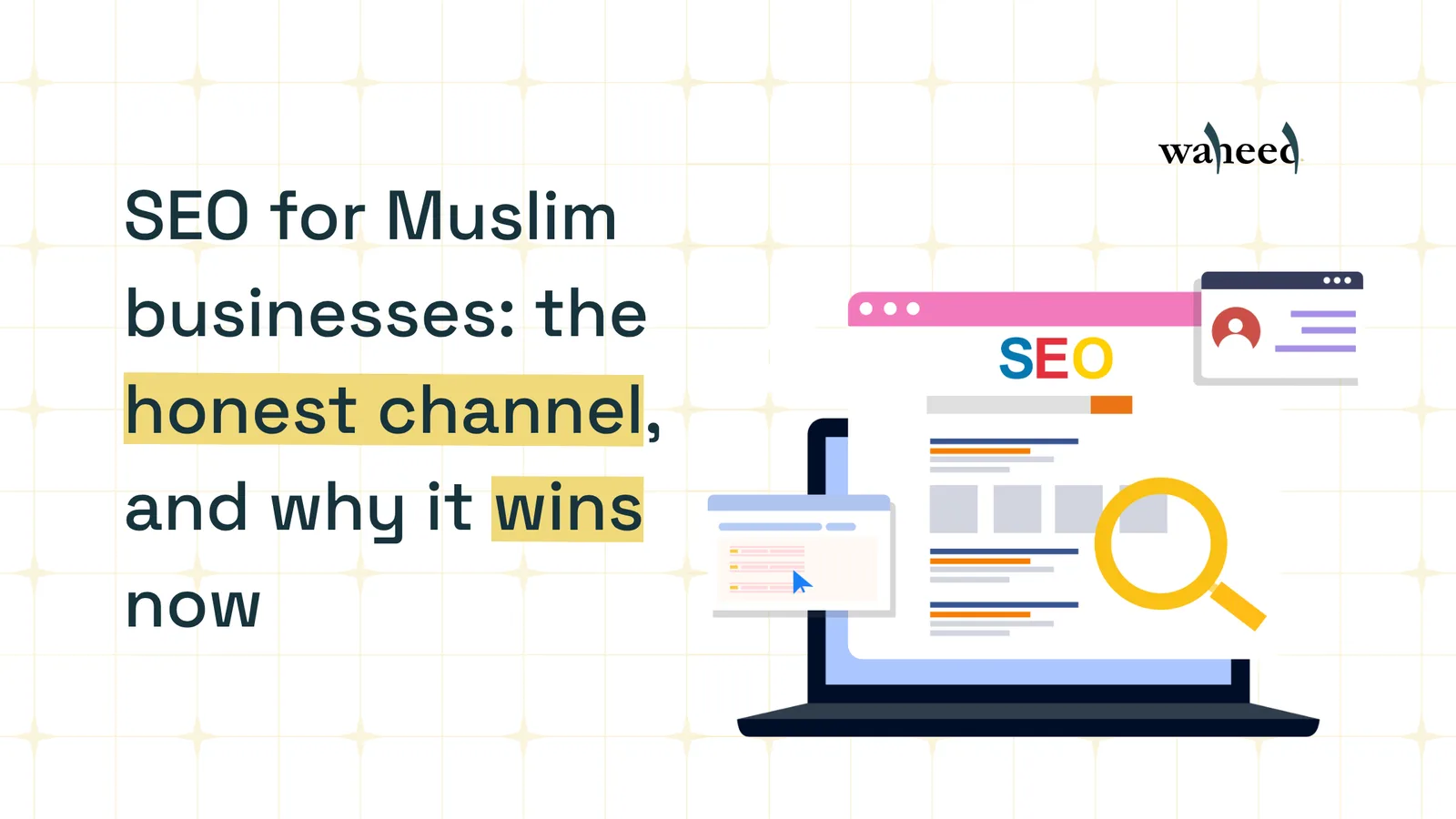
If you run a Muslim or halal business and you have to choose one marketing channel to build on, choose search. SEO for Muslim businesses is not just permissible, it is the channel whose incentives line up most closely with how Islam says you should sell: it rewards being accurate and useful, and it punishes the deceptive tactics over time. You earn a position by deserving it, not by paying to jump the queue or by shouting louder than the truth allows. That is a rare thing in marketing, and it is worth building on.
This guide is written to be its own proof. It is the kind of page that ranks: a real answer to a real question, sourced, without padding. By the end you will know why SEO suits a halal business specifically, how to do the parts that matter without a budget for ads, and how the shift to AI search changes the work without changing the principle. No jargon for its own sake, and nothing you have to take on trust.
Why SEO for Islamic businesses fits the deen, not just the budget
Start with the money worry, because it is usually the real question underneath. Paid ads cost every time someone clicks. Stop paying and the traffic stops the same day. SEO is the opposite shape: the work compounds, and a page that earns its ranking keeps earning long after you wrote it. For a business that would rather not rent its customers, that is the difference between an asset and an expense.
But the deeper fit is ethical. Good search rankings go to pages that answer the query honestly and completely, and Google spends enormous effort demoting thin, misleading, or manipulative content. The behaviour that ranks is, roughly, the behaviour Islam already asks of a seller: describe the thing truthfully, do not conceal its faults, do not over-promise. The standard for honest trade is set out plainly in the ruling on commercial advertising by Islam Question and Answer, which requires that what you say reflects the reality of the product and forbids exaggeration and concealment. It is the same standard we apply across every channel in our guide to whether digital marketing is halal, and search is where it costs you least to uphold. SEO done properly is one of the few marketing disciplines where following that ruling and following the algorithm point in the same direction.
This is why SEO for Islamic businesses tends to be the safest large channel to build on, and why the rest of this guide treats honesty as a strategy rather than a constraint. You are not fighting the medium to stay within the deen. You are using a medium that happens to reward the deen.
The SEO that actually moves the needle, without paying for ads
Most of what agencies charge for is a handful of things done consistently. You can do them yourself. Here is the order that matters.
1. Answer the questions your customers actually type
Every piece of content should map to a real question a real customer asks. Not "our services" but "how much does a halal will cost in the UK" or "is takaful the same as insurance". Search the phrase, read what currently ranks, and write something more useful and more honest than that. This is keyword research stripped of the mystique: find the question, deserve the answer.
2. Make each page about one thing
A page that tries to rank for everything ranks for nothing. One page, one primary question, a title and headings that name it, and body copy that genuinely resolves it. Internal links between related pages tell search engines how your site fits together and keep readers moving through it.
3. Earn trust signals the slow way
Google weighs expertise, experience, authoritativeness and trust. For a Muslim business that means real author names, real credentials, citations to real scholarship where you make a religious claim, and pages that a knowledgeable reader would find sound. There is no shortcut here that is also halal: buying links and spinning fake reviews are both the deceptive najsh that Islam forbids and the manipulation Google penalises. The slow way is the only way that lasts.
4. Fix the technical basics once
A site that loads fast, works on a phone, has clean URLs, and can be crawled will outrank a prettier site that fails those tests. These are mostly one-time fixes. Get them done and stop worrying about them.
How AI search changed the rules, and what stayed the same
Here is the part every business owner is anxious about, and the numbers justify the anxiety. Google now places an AI-generated summary at the top of many results, and it is measurably reducing clicks to websites. In a behavioural study of nearly 69,000 searches by 900 US adults, the Pew Research Center found that users clicked a traditional search result in only 8% of visits when an AI summary appeared, compared with 15% when it did not, roughly half. Clicking a link inside the summary itself happened in just 1% of visits. Users were also more likely to end their session entirely after seeing a summary, 26% of the time versus 16%.
Read plainly, that means ranking first is no longer the same as getting the click. On a large share of informational queries, Google now answers the question on the results page and the user never arrives. For a business that assumed "rank number one and the traffic follows", the ground has moved.
The new job: be the source the AI cites
What has not changed is that the AI has to get its answer from somewhere. Those summaries are built from web pages, and they cite them. The work is no longer only about ranking; it is about being one of the sources the AI pulls from and names. This is often called AI SEO, or generative engine optimisation: writing so that a machine summarising your topic reaches for your page.
The uncomfortable good news is that the way you do this is mostly the way you should have been writing anyway. Machines summarising a topic favour pages that answer a specific question directly and early, that are structured with clear headings, that state facts plainly and attribute them, and that carry the trust signals above. In other words, AI SEO rewards the honest, well-sourced, single-purpose page even harder than classic SEO did. The manipulative playbook that never sat right with a Muslim owner is also the playbook that AI search ignores.
What to do differently in practice
Put a direct, quotable answer near the top of each page, in plain sentences a summary could lift.
Use clear question-shaped headings, because question-form and longer queries are the ones most likely to trigger an AI summary.
Attribute your facts to named, checkable sources, which is both what earns machine trust and what the deen requires of a claim.
Build genuine authority on a topic rather than one-off pages, so you are the obvious source across a whole subject.
Track more than clicks. If the AI is answering with your content, you are gaining visibility and trust even on the visits that do not become a click, and some of those users come to you later by name.
None of this is exotic and none of it is against the grain of an honest business. It is the same discipline, pointed at a results page that now has a machine sitting on top of it.
Do you actually need to pay an agency?
Honestly, not always, and it would be against our own advice to pretend otherwise. If you have the time to learn and apply the four fundamentals above, a small local or niche business can get a long way alone. The reading is free and the tools have generous free tiers.
Where an agency earns its fee is speed, competitive markets, and the technical and authority-building work that has a real learning curve. If a competitor is already investing and you are starting from behind, or if your own time is worth more spent running the business, paying someone to compress months into weeks is a rational trade. The test is not "can I afford it" but "is my time better spent elsewhere, and is this market competitive enough to need the pace".
If it is, choose someone who will tell you when you do not need something. A halal SEO service for Muslim and Islamic businesses should be as willing to talk you out of unnecessary work as into it, because that willingness is the same honesty the whole channel rewards. If you want to work out where your site stands against the four fundamentals and the AI shift, you can book a free clarity call and we will tell you plainly whether this is worth paying for in your case.
The one-line version
SEO for Muslim businesses works because the medium pays you for exactly the honesty your faith already asks of you, and the arrival of AI search has made that alignment stronger, not weaker. Build the honest, well-sourced, single-purpose pages, earn your authority the slow way, and you are optimising for Google, for the AI sitting on top of Google, and for the standard you are supposed to trade by, all at once.