What actually makes halal ecommerce halal
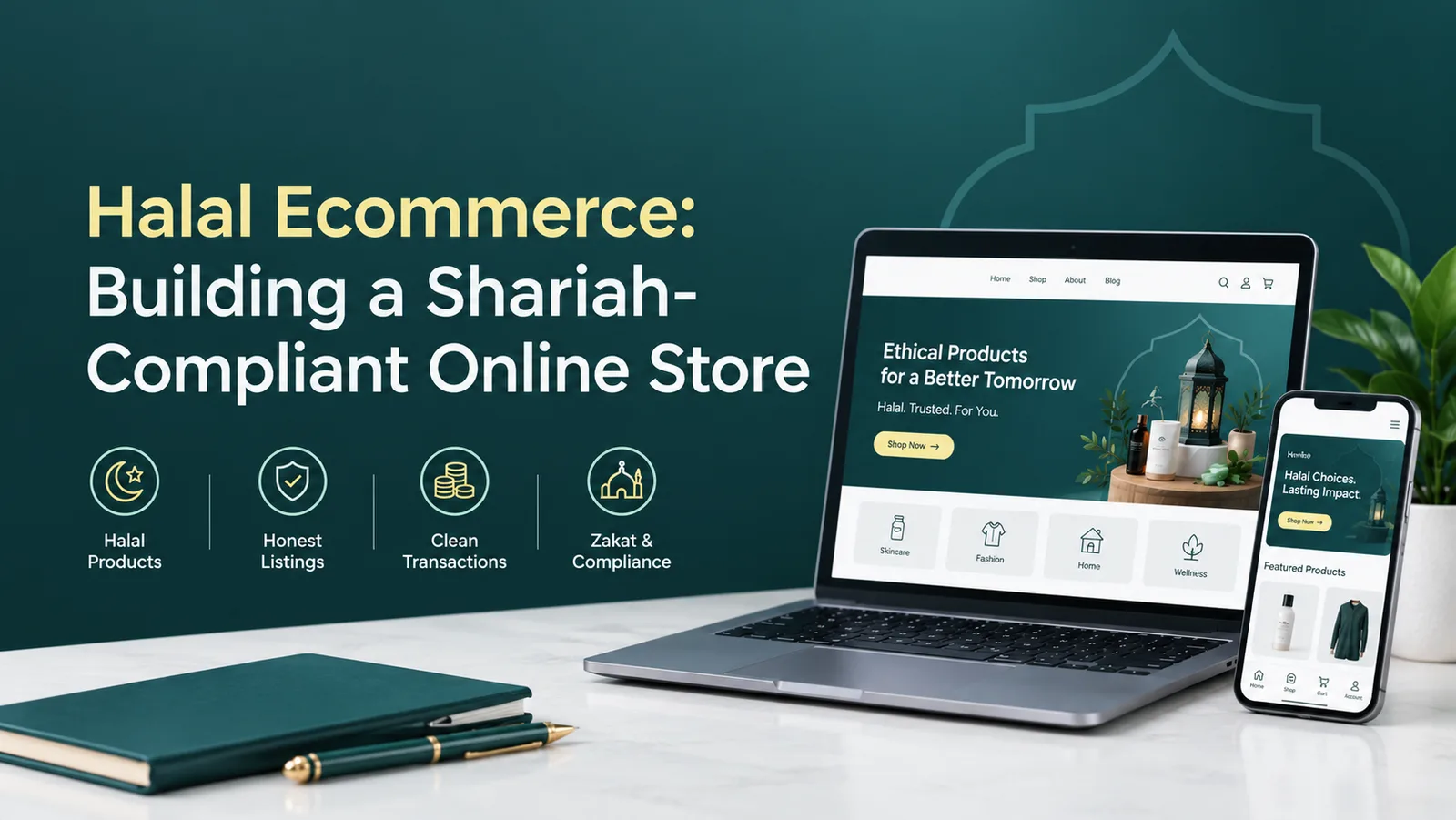
Halal ecommerce is not a platform, a plugin or a green colour scheme. A Shariah-compliant online store is one that passes four tests: what it sells is halal, it owns what it sells at the moment it sells it, it describes and prices things honestly, and it handles the money cleanly. The software you build it on barely matters. A store on a mainstream platform that passes those four tests is halal. A beautifully branded "Islamic" store that fails one of them is not.
That is the whole argument of this guide, and it is worth stating plainly because most of what is written about halal ecommerce stops at the first test. "Don't sell pork or alcohol" is true and nobody needs telling. The tests that actually catch Muslim store owners are the second and third, because standard ecommerce playbooks are built on practices that fail them: selling stock you have not bought yet, mystery boxes, manufactured urgency and reviews of uncertain origin. We take each test in turn, then what it means for the build.
Test one: is what you sell halal?
This is the obvious one, so we will keep it short. The product itself must be permissible, and so must anything you promote alongside it: affiliate links, sponsored placements, cross-sells from other brands. The ruling attaches to what you help sell, not only to what you make.
The harder cases are products that can be used well or badly, such as cosmetics, clothing, or software. Scholars treat those case by case rather than with a blanket rule: the Islam Question and Answer ruling on dropshipping treats selling something usable for both permissible and sinful ends as needing separate discussion, not a one-line answer. If your catalogue sits in that zone, it is worth one conversation with a scholar about your specific products before you scale.
Test two: do you own it when you sell it?
This is the test that ecommerce fails most often, because the dominant online business model of the last decade is built on not owning stock. The governing text is a hadith narrated by Hakim ibn Hizam, who asked the Prophet (peace and blessings be upon him) whether he could sell a man something he did not have and then go and buy it from the market. The answer was: do not sell what you do not have.
What follows from that hadith for a modern store is where scholars part ways in practice, and the difference matters for your business model.
The strict reading
A fatwa from Darul Ifta Birmingham, citing that hadith from Sunan an-Nasa'i, describes dropshipping as selling an item you do not own and then ordering it from someone else to deliver, and rules that this is not allowed. The same fatwa adds that there is no harm in using a platform like Shopify itself, so long as the transactions on it are Shariah compliant. The problem is the model, not the tool.
The corrective reading
That same Islam Question and Answer ruling agrees that selling what you do not possess is impermissible, and also that you cannot sell something you have bought until you have taken possession of it. But it then sets out four ways the dropshipping model can be corrected:
structure the sale as a salam (advance payment) transaction, following its conditions;
structure it as profit-sharing;
act as the customer's agent, taking their money and buying with it, rather than buying with your own money and asking them to repay you;
act as the agent of the original seller, presenting their product for a known commission.
Read together, the practical upshot is the same: the classic model, where you list a product as your own, take the customer's money, and only then buy it from a supplier who ships direct, fails this test under both readings. Where they differ is whether a restructured version can pass. If you want to sell without holding stock, the agency model (being openly the supplier's agent for a commission) is the route most stores can implement, but take your exact arrangement to a scholar before you build around it.
What about pre-orders?
Pre-orders are where salam becomes directly relevant, and it has a condition that most pre-order setups break. The same IslamQA ruling states that in a salam transaction it is essential to receive the price in full when the contract is made. A pre-order that takes full payment at checkout for a precisely described product is on firmer ground. A pre-order that takes a deposit now and the balance later is a different arrangement, and one to check with a scholar rather than assume.
Test three: are your listings honest?
The third test is where conversion advice and the deen most often collide. The standard is set by a hadith in Sahih Muslim: the Prophet (peace and blessings be upon him) put his hand into a heap of grain, found the lower part wet from rain, and asked the seller why he had not put the wet part on top where people could see it, adding that whoever deceives is not of him. The fault was not that the grain was damp. It was that the display hid it.
Translated to a product page, that means photographs that show the real item, descriptions that state the flaws and limits as clearly as the benefits, and sizing, materials and condition stated plainly. It also rules out a set of tactics that are common enough to feel normal.
Mystery boxes and lucky dips
Selling a sealed box whose contents the buyer cannot know is a specific problem. A ruling from the Permanent Committee, reproduced by Islam Question and Answer, concerns sealed "try your luck" boxes each containing a different toy, and holds that selling them is not permissible because the buyer has no knowledge of what is being sold either by sight or by description, making it a deceptive sale of the kind the Prophet forbade. If you want the fun of a bundle, sell a described bundle: the buyer should know what they are paying for.
Exaggeration, urgency and reviews
On advertising generally, Islam Question and Answer sets out that what a seller says must reflect the reality of the product, and forbids exaggerating its qualities, concealing its faults or claiming features it does not have. Countdown timers that reset, "only two left" banners on unlimited stock, and "was" prices that were never charged all fail that standard.
Reviews are now a legal question as well as a religious one in the UK. The Competition and Markets Authority's guidance for businesses publishing consumer reviews says that any trader publishing reviews must take reasonable steps to prevent and remove fake reviews, reviews that hide the fact they were incentivised, and misleading aggregate ratings, and should publish a policy that clearly prohibits fake reviews. A halal store would refuse bought reviews on principle anyway. The law now means the review section needs a written policy and a process behind it.
The legal minimum overlaps with the deen
UK law also sets out what a buyer must be told before ordering. The government's guide to online and distance selling requires a description of the goods, the price including all taxes, delivery costs and timings, and how to cancel. It also says you must tell customers they can cancel up to 14 days after delivery without giving a reason, and that if you fail to tell them, they can cancel at any time in the next 12 months. The guide lists exceptions, including goods worth £42 or less, so check where your orders fall. A clear returns page is not just compliance: it is the modern form of letting the buyer see the wet grain.
Test four: is the money clean?
The fourth test covers how money comes in and what happens to it. On the way in, the main risks sit around the payment gateway rather than in it: surcharges for card payments, interest on late invoices, and pay-later products at checkout whose cost to the customer grows with time. In short: taking card payments through a mainstream processor is fine, and charging for time on a debt is not.
The part most store owners forget is zakat on stock. Inventory you hold for sale is trade goods, and Islam Question and Answer rules that zakat on trade goods is worked out on their market value once a full year has passed, usually the price they sell for in the store, whatever you originally paid, at a rate of 2.5%. It adds that a wholesaler should value stock at the wholesale price and a retailer at the retail price. For an online store this means your zakat calculation needs a stock valuation at a fixed date each year, which is something your store's reporting should be able to give you in a few clicks.
Does the platform matter for a Shariah-compliant online store?
Honestly, very little, and we would rather say so than sell you something. As the Birmingham fatwa puts it, using a mainstream platform is fine if the transactions on it are compliant. A small shop selling its own halal stock, with honest listings and a sensible checkout, can run perfectly well on an off-the-shelf platform with no custom development at all. If that is you, you do not need an "Islamic ecommerce platform". You need the four tests applied to the store you already have.
Where the build starts to matter is when the four tests have to be enforced by the software rather than remembered by a person. Some examples we see:
a pre-order flow that only accepts full payment at checkout for described goods, so a deposit option cannot be switched on by accident;
a store selling on behalf of suppliers that has to show, on every page and in every receipt, that it acts as their agent for a commission;
listing templates that require condition, materials and known flaws before a product can be published;
a review system with a published policy, moderation and no incentive mechanics hidden inside it;
a stock valuation report, at retail or wholesale price, on the date your zakat falls due.
That is the kind of store our halal web design and development for Muslim businesses is built to deliver: the compliance written into the build once, so nobody has to police it by hand. If your model is closer to a multi-vendor marketplace or needs bespoke order logic, that sits with our custom software development work instead. And if you are not sure which side of the line your store is on, book a free clarity call and we will tell you plainly, including when the answer is that you need nothing built at all.
A halal ecommerce checklist
Every product, affiliate link and cross-sell is itself halal.
You own and possess what you sell when you sell it, or your model is openly restructured as agency, profit-sharing or a proper salam sale, checked with a scholar.
Pre-orders take full payment at checkout for precisely described goods.
No mystery boxes or sealed lucky dips; bundles are described.
Photos and descriptions show flaws and limits as clearly as benefits.
No fake urgency, fake scarcity or invented "was" prices.
A published review policy, no bought or hidden-incentive reviews.
Clear pre-order information and a 14-day cancellation notice for UK buyers.
No card surcharges, no interest on late payments, no pay-later product whose cost grows with time.
A yearly stock valuation for zakat at your selling price.
The one-line version
Halal ecommerce is ordinary ecommerce with four questions asked honestly: is it halal, is it mine, is it described truthfully, and is the money clean? The platform is a detail. Where scholars differ, as they do on how far dropshipping can be repaired, take your exact setup to one you trust before you build around it.